

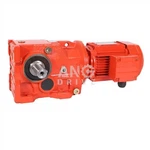
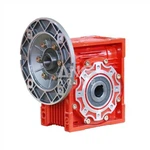

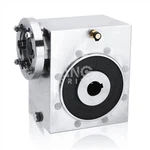
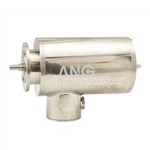
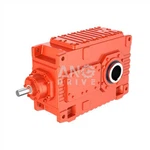
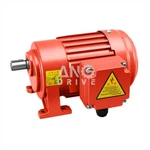
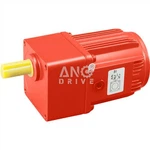
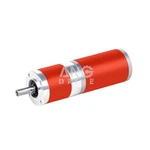
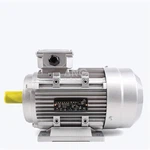
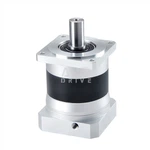


DC Gear
DC Gear Parameters:
1) Dimensions: 16~130mm
2) Power: 3~2200W
3) Voltage: 12V 24V 48V 90V 310V
4) Rated speed: 2000rpm, 3000rpm
5) Reduction ratio: 3~ 200K
DC Gear Features:
1. Compact structure and simple assembly;
2. Wide speed ranges and high torque;
3. Low noise, good sealing performance, high efficiency;
4. Stable and safe, long lifetime, universal;
5. Multi-structure, various assembling methods
DC Gear Applications:
1. Industrial Automation
Conveyor Belts and Automated Assembly Lines: DC gear motors are often used to drive conveyor belts and automated assembly lines, ensuring the stable transport of materials and products in the production process. Their high precision and stable performance help increase production efficiency and product quality.
Robotic Arms and Robots: In automated production lines, robotic arms and robots extensively use DC gear motors. These devices require precise control of movement and positioning, and DC gear motors provide stable power output and accurate speed control to meet these needs.
2. Home Appliances
Electric Doors and Curtains: In modern homes, electric doors, curtains, and other smart home devices are becoming increasingly popular. DC gear motors, as the core component of these devices, provide smooth and quiet power output, enhancing the convenience and comfort of home life.
Washing Machines and Dryers: Home appliances like washing machines and dryers also widely use DC gear motors. These devices need precise control of speed and torque to ensure effective washing and drying. DC gear motors meet these requirements while reducing noise and energy consumption.
3. Medical Equipment
Medical Robots: In the medical field, DC gear motors are used to drive medical robots. These robots require precise control of motion and positioning to perform tasks such as surgery and care. DC gear motors provide stable and reliable power output, ensuring the safety and effectiveness of medical robots.
Medical Equipment Drive Systems: Some medical devices, such as CT scanners and MRI machines, also use DC gear motors as key components in their drive systems.
4. Other Fields
Financial Equipment: DC gear motors are used in financial equipment like ATMs and bill counters.
Office Equipment: Office devices like printers and scanners also commonly use DC gear motors in their transmission systems.
Transportation: In electric vehicles, electric bicycles, and other forms of transportation, DC gear motors play an important role by providing stable power output, helping vehicles achieve smooth operation and precise control.
Electric Glass Doors and Windows: DC gear motors are also widely used in electric glass doors and windows, providing stable opening and closing power.
Precision Instruments: DC gear motors are also commonly used in precision instruments such as optical instruments and measuring devices.
Remote-Controlled Toys: Some high-end remote-controlled toys use DC gear motors to provide stable power output and precise control.
Additionally, DC gear motors play important roles in industries such as food processing, conveyor systems, packaging, and CNC (computer numerical control) applications. In food processing, DC gear motors meet the hygienic, precise, and stable requirements of food machinery; in the conveyor industry, they are used to drive various conveyor systems, improving logistics efficiency; in the packaging industry, they help drive packaging machinery, improving efficiency and product quality; and in CNC applications, DC gear motors serve as key components in CNC machining centers, providing precise power output and speed control.
DC Gear Specification:
|
Product Name |
ANG DC gear motor |
||
|
Motor type |
Brush type / Brushless type / Stepper type |
||
|
Frame size |
16mm ~ 130mm... can be customized |
||
|
Running speed |
Motor 1500-4000 rpm, Gear Ratio 1/3 ~ 1/3000 |
||
|
Output power |
3W ~2200W... can be customized |
||
|
Output shaft |
round shaft, D-cut shaft, key-way shaft, hollow shaft… |
||
|
Voltage type |
12V / 24V / 36V / 48V / 90V / 110V /220V... can be customized |
||
|
Accessories |
Internal driver / External driver / Connector / Brake / Encoder… |
||
|
Gearbox type |
Parallel shaft |
||
|
Right angle hollow worm shaft |
Right angle bevel hollow shaft |
Flat type hollow shaft |
|
|
Right angle solid worm shaft |
Right angle bevel solid shaft |
Flat type solid shaft |
|
|
Planetary center shaft |
|||
A coil of wire with a current running through it generates an electromagnetic field aligned with the center of the coil. The direction and magnitude of the magnetic field produced by the coil can be changed with the direction and magnitude of the current flowing through it.
A simple DC gear motor has a stationary set of magnets in the stator and an armature with one or more windings of insulated wire wrapped around a soft iron core that concentrates the magnetic field. The windings usually have multiple turns around the core, and in large motors there can be several parallel current paths. The ends of the wire winding are connected to a commutator. The commutator allows each armature coil to be energized in turn and connects the rotating coils with the external power supply through brushes. (Brushless DC motors have electronics that switch the DC current to each coil on and off and have no brushes.)
The total amount of current sent to the coil, the coil's size and what it's wrapped around dictate the strength of the electromagnetic field created.
The sequence of turning a particular coil on or off dictates what direction the effective electromagnetic fields are pointed. By turning on and off coils in sequence a rotating magnetic field can be created. These rotating magnetic fields interact with the magnetic fields of the magnets (permanent or electromagnets) in the stationary part of the motor (stator) to create a torque on the armature which causes it to rotate. In some DC motor designs the stator fields use electromagnets to create their magnetic fields which allow greater control over the motor.
At high power levels, DC motors are almost always cooled using forced air.
Different number of stator and armature fields as well as how they are connected provide different inherent speed/torque regulation characteristics. The speed of a DC motor can be controlled by changing the voltage applied to the armature. The introduction of variable resistance in the armature circuit or field circuit allowed speed control. Modern DC motors are often controlled by power electronics systems which adjust the voltage by "chopping" the DC current into on and off cycles which have an effective lower voltage.
Since the series-wound DC motor develops its highest torque at low speed, it is often used in traction applications such as electric locomotives, and trams. The DC motor was the mainstay of electric traction drives on both electric and diesel-electric locomotives, street-cars/trams and diesel electric drilling rigs for many years. The introduction of DC motors and an electrical grid system to run machinery starting in the 1870s started a new second Industrial Revolution. DC motors can operate directly from rechargeable batteries, providing the motive power for the first electric vehicles and today's hybrid cars and electric cars as well as driving a host of cordless tools. Today DC motors are still found in applications as small as toys and disk drives, or in large sizes to operate steel rolling mills and paper machines. Large DC motors with separately excited fields were generally used with winder drives for mine hoists, for high torque as well as smooth speed control using thyristor drives. These are now replaced with large AC motors with variable frequency drives.
If external mechanical power is applied to a DC motor it acts as a DC generator, a dynamo. This feature is used to slow down and recharge batteries on hybrid and electric cars or to return electricity back to the electric grid used on a street car or electric powered train line when they slow down. This process is called regenerative braking on hybrid and electric cars. In diesel electric locomotives they also use their DC motors as generators to slow down but dissipate the energy in resistor stacks. Newer designs are adding large battery packs to recapture some of this energy.
Hot Tags: dc gear, China, suppliers, manufacturers, factory, wholesale, price
Previous
Motor Gearbox DcYou Might Also Like


Send Inquiry