

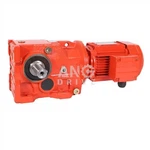
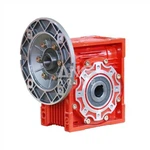

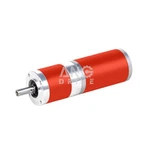
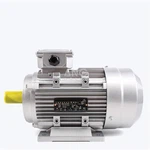
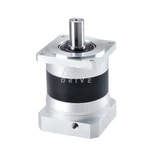


Industrial Servo
The first servomotors were developed with
The first servomotors were developed with synchros as their encoders. Much work was done with these systems in the development of radar and anti-aircraft artillery during World War II.
Simple servomotors may use resistive potentiometers as their position encoder. These are only used at the very simplest and cheapest level and are in close competition with stepper motors. They suffer from wear and electrical noise in the potentiometer track. Although it would be possible to electrically differentiate their position signal to obtain a speed signal, PID controllers that can make use of such a speed signal generally warrant a more precise encoder.
Modern servomotors use rotary encoders, either absolute or incremental. Absolute encoders can determine their position at power-on but are more complicated and expensive. Incremental encoders are simpler, cheaper, and work at faster speeds. Incremental systems, like stepper motors, often combine their inherent ability to measure intervals of rotation with a simple zero-position sensor to set their position at start-up.
Instead of servomotors, sometimes a motor with a separate, external linear encoder is used.[9] These motor + linear encoder systems avoid inaccuracies in the drivetrain between the motor and linear carriage, but their design is made more complicated as they are no longer a pre-packaged factory-made system.

1. Low noise and long life
2. Efficient and energy saving
3. Easy to operate
4. High precision and accuracy
5. Wide voltage and power range













Hot Tags: industrial servo, China, suppliers, manufacturers, factory, wholesale, price
Previous
Speed Reduction GearboxNext
Blower MotorYou Might Also Like


Send Inquiry