




Large Diameter Gear
A large diameter gear is one of the commonly used mechanical parts, which is to transfer and change the direction of the torque, especially in the rotary kiln, the large diameter gear is one of the key parts of the rotary kiln transmission, it is also widely used in other application that require high torque and low cost transimission.
Large Diameter Gear Features
1. Large diameter gear is suitable for large torque operation.
2. OEM and customizable according to drawings.
3. Related transmission parts can be provided, like gearbox, motor, oil station, control system, etc.
4. Heavy Load, it can be separated into several segments, like 2 pieces, 4 pieces, and 8 pieces.
Specification
| Name | AnJo large diameter gear |
| Typical module | 20 or others |
| Precision grade | Class 6, Class 7, Class 8 |
| Section | 1 segment, 2 segments, 4 segments, 8 segments, etc. |
| Typical material |
Medium Carbon Steel: 35# steel, 45# steel Carburizing Steel: 20CrMnTi, 20CrMnMo, 20CrMo |
| Heat treatment of teeth | Hardening & Tempering, Surface Quenching, |
| Application | Rotating Kiln, Drying Equipment, Roller, Dryer, etc. |
| Machining process | Die casting, Machining, Hobbing, Milling, Shaving, Grinding, Heat treatment, Polishing, Antirust treatment |
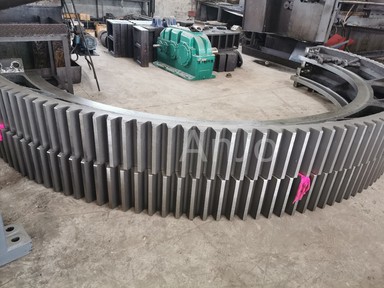
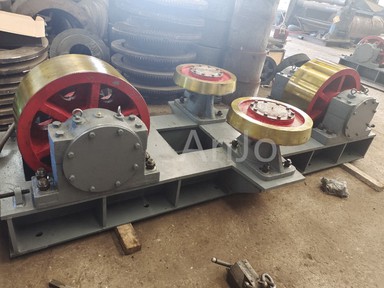
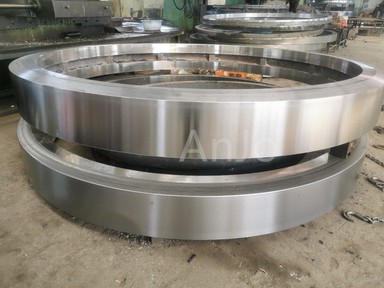
Large Diameter Gear Photos




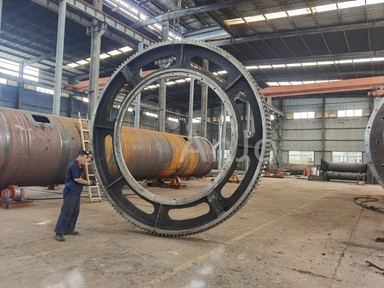


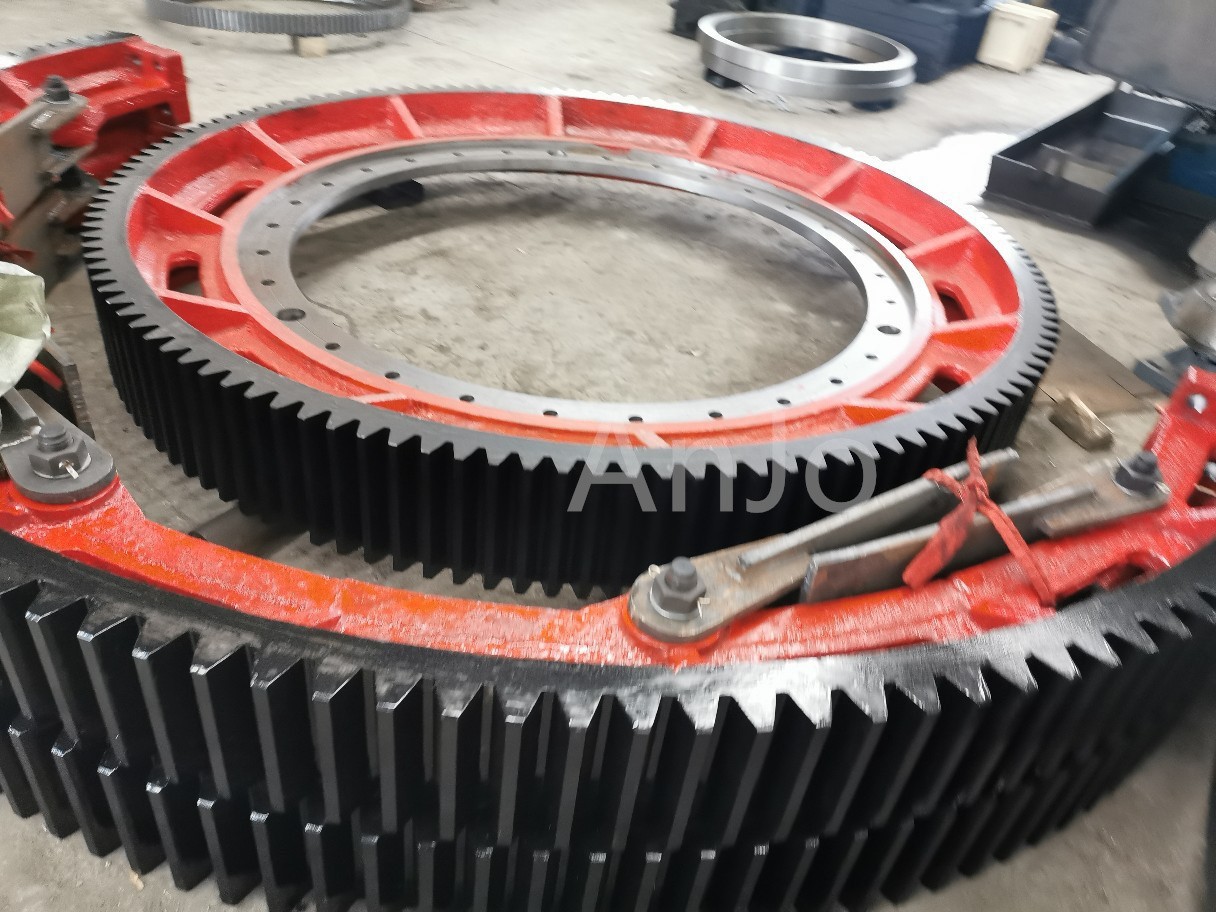
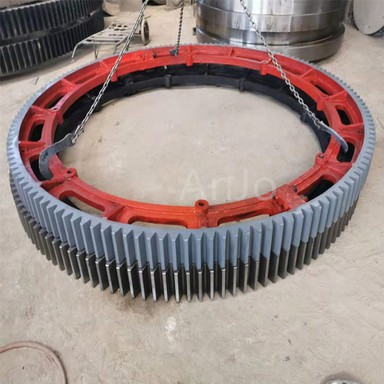

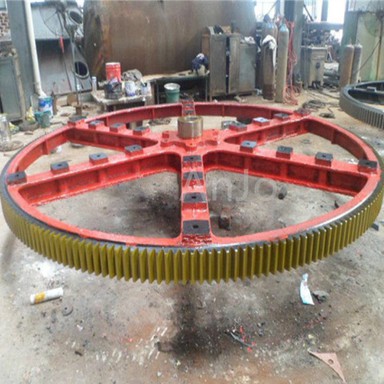


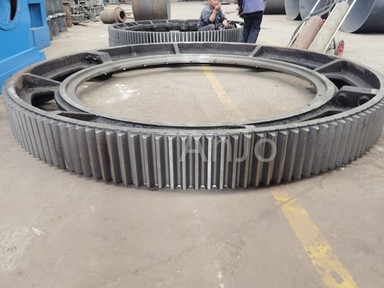


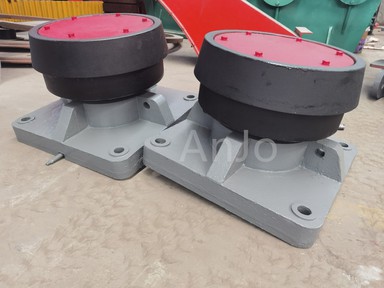

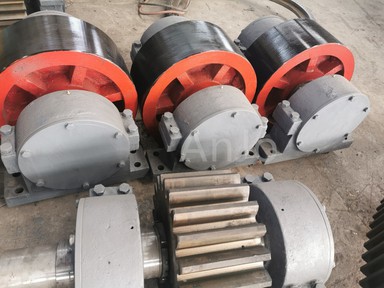


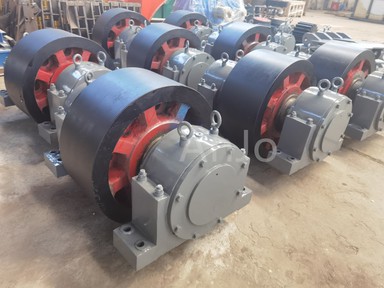




Why choose Our Large Diameter gear?

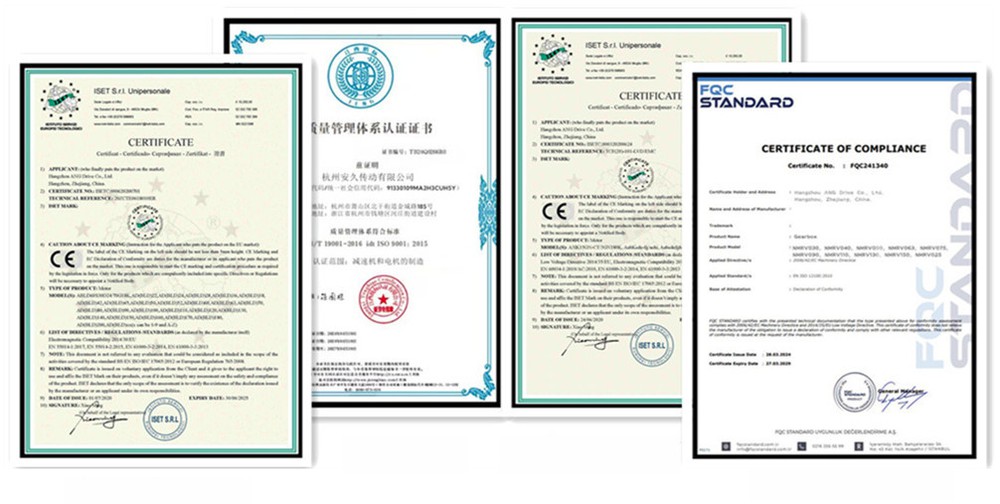
Our certificates
What is Large diameter gear?
Large diameter gears usually refer to gears with a larger outer diameter. Here's a little bit about it.
Large size and weight: The outer diameter size of the large diameter gear is significantly larger than that of the ordinary gear, and the corresponding weight is also larger, such as the "Big MAC" gear with a diameter of 6 to 10 meters.
The number of teeth, small tooth Angle: the general number of teeth is more, and the Angle of each tooth is smaller. For example, for gears with 200 teeth and 20 modules, the Angle of each clamp is 1.8°.
High manufacturing difficulty: due to the large size, the casting, forging, processing, measurement and other links are facing greater challenges, and the process and equipment requirements are high.
What is the application of Large diameter gear?
Power industry: In wind power generation, the speed box, yaw system and variable pitch system of wind turbines often use large-diameter gears to transmit the huge torque and power generated by wind turbines. In hydroelectric power stations, large diameter gears are also used in the transmission system of the hydrogenerator to transmit the rotating motion of the turbine to the generator rotor.
Mining machinery: such as ball mill, crusher and other equipment transmission device, large diameter gear is used to transfer the power of the motor to the working parts, in order to achieve the grinding of ore and other materials, crushing and other operations.
Marine industry: In the propulsion system of the ship, the large diameter gear, as a key component of the reduction gear box, converts the high speed and low torque of the engine into the low speed and high torque required by the propeller to push the ship forward.
What is the Processing technology of Large diameter gear?
Blank manufacturing
Casting: Suitable for large diameter gears with complex shapes, such as using sand casting, precision casting and other methods to manufacture gear blanks, which can obtain close to the final shape of the blank and reduce the amount of subsequent processing.
Forging: can improve the internal organization of the metal, improve the strength and toughness of the gear, through free forging, die forging and other ways to process the metal billet into the gear blank.
Machining
Turning: On the vertical lathe or horizontal lathe, the outer circle, inner hole and end face of the gear blank are processed to ensure dimensional accuracy and form tolerance.
Milling: The use of milling machines and milling cutters to rough and semi-finish the tooth slots of the gear to prepare for subsequent hobbing or gear shaper processes.
Hobbing: It is a common method of machining the tooth shape of large diameter gear. The relative motion between the hob and the gear blank is used to cut the involute tooth shape.
Gear shaper: For some internal gears or double gears, gear shaper process can be used to process its tooth shape, through the up and down reciprocating movement of the gear shaper cutter and circular feed movement, complete the cutting of the tooth shape.
Gear grinding: In order to improve the precision and surface quality of the gear, grinding the gear after hobbing, gear shaper and other processing can eliminate the error of heat treatment deformation.
Heat treatment: quenching, tempering, carburizing, nitriding and other heat treatment of the gear after processing, improve the hardness, strength and wear resistance of the gear and improve the comprehensive mechanical properties of the gear.
Surface treatment: The use of hard chrome plating, nickel plating, blackening and other surface treatment processes, improve the corrosion resistance and surface finish of the gear, reduce the friction coefficient, extend the service life of the gear.
What are the difficulties of the processing process of Large diameter gear?
Large diameter gear processing technology has many difficulties, mainly reflected in the following aspects:
Material selection and handling
Material quality control: Large diameter gears usually bear large loads and torques, and have high requirements for the strength, toughness and wear resistance of materials. It is difficult to ensure that the material has no defects, uniform composition and stable performance, because any small material problem can cause serious failure during the operation of the gear.
Forging ratio control: In order to obtain good material properties, large diameter gear blank often adopts forging process. However, it is not easy to achieve the right forging ratio, too large or too small forging ratio may lead to uneven material organization, affecting the overall performance of the gear.
Machining accuracy guarantee
Tooth shape machining accuracy: The tooth shape machining of large diameter gear is more difficult, because of the large size, in the process of hobbing, gear shaper and other processing, the relative motion precision control between the tool and the workpiece is required to be high. Small tool vibration, machine tool transmission error and so on May lead to the increase of tooth profile error, affect the transmission smoothness and meshing accuracy of the gear.
Pitch precision control: the number of teeth of large diameter gear is large, and the precision of tooth splitting is high. In the process of machining, the accuracy of the machine tool index mechanism, the wear of the tool and the clamping error of the workpiece may lead to the cumulative error of the pitch beyond the allowable range, affecting the transmission accuracy and carrying capacity of the gear.
Shape and position tolerance control: It is difficult to control the shape and position tolerance of large diameter gear such as cylindricity, flatness and coaxial degree. For example, when turning the outer circle and the end face, due to the large size of the workpiece, cutting force, cutting heat and other factors are easy to cause the workpiece deformation, resulting in out-of-tolerance of form and position.
Processing efficiency improvement
Cutting parameters optimization: When machining large diameter gear, due to the large amount of material removal, it is necessary to select the appropriate cutting parameters to improve the processing efficiency. However, the choice of cutting parameters is limited by many factors such as tool life, machine power, workpiece material and so on. How to optimize cutting parameters to improve processing efficiency under the premise of ensuring processing quality is a difficult problem.
Tool wear problem: In the machining process of large-diameter gear, tool wear is faster, and frequent tool replacement will increase the processing auxiliary time and reduce the processing efficiency. Therefore, it is necessary to develop and apply tools with high performance and long life, and adopt reasonable tool wear monitoring and compensation technology.
Quality inspection and control
Testing equipment and methods: The size of large diameter gear is beyond the measuring range of ordinary testing equipment, and special large measuring instruments and equipment are needed, such as large size gear measurement center. In addition, due to the complex structure of the gear, the detection of some internal defects and hidden parts is difficult, and advanced non-destructive testing technology needs to be used, such as ultrasonic testing and X-ray testing.
Data processing and analysis: The detection data of large diameter gear is large, how to process and analyze these data quickly and accurately to judge the quality of gear and take timely adjustment measures is also a difficult point in quality control.
Assembly and transportation
High assembly accuracy requirements: large diameter gears are usually assembled with other large components, such as in large reducer, Marine propulsion system, gear and shaft, box and other components of the assembly accuracy requirements. Due to the large size of the gear, it is difficult to locate and adjust in the assembly process, and special assembly processes and equipment are required to ensure the assembly quality.
Transportation and lifting difficulties: large diameter gear weight, large volume, transportation and lifting process need to use special transport tools and lifting equipment. At the same time, to ensure that the gear is not damaged during transportation and lifting, there are high requirements for packaging, fixing and lifting schemes.
Hot Tags: large diameter gear, China, suppliers, manufacturers, factory, wholesale, price
Previous
Large Gear WheelNext
Girth RingYou Might Also Like


Send Inquiry