

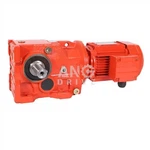

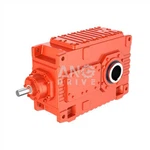
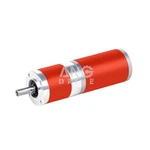
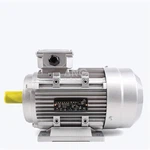
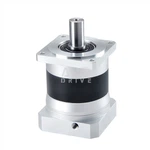


Crusher Gear Unit
General Specification of crusher gear unit:
|
High torque option of crusher gear unit |
|
| Types | Helical parallel shaft type, Bevel helical right angle type |
| Model |
H1/B4~H26/B26 |
|
Motor power |
3 ~ 5000 KW; |
|
Motor speed |
750rpm ~ 3000rpm |
|
Reduction ratio |
1/1.25 ~ 1/450 |
|
Final torque |
3 ~ 900kN.m |
|
Install type |
Foot / Solid shaft / Hollow shaft / Output flange |
|
Efficiency |
2 stage 96%, 3 stage 94%, 4 stage 92% |
|
Precision of gear |
Accurate grinding, class 6 |
|
Assemble types |
A / B / C / D / E / F / G / H / I |
Rated torque and power of crusher gear unit:
|
Size |
Ratio |
Rated Output Torque (KN.m) |
Rated Input Power(KW) |
|
H1-3 |
1.25-5.6 |
2.3-3.2 |
30-352 |
|
H1-5 |
1.25-5.6 |
6.9-9.6 |
91-972 |
|
H1-7 |
1.25-5.6 |
13.1-17.8 |
174-1845 |
|
H1-9 |
1.25-5.6 |
20.1-28.7 |
267-3000 |
|
H1-11 |
1.6-5.6 |
36.5-50.6 |
485-4367 |
|
H1-13 |
1.6-5.6 |
55.4-77 |
736-4676 |
|
H1-15 |
2-5.6 |
90.4-130 |
1200-4704 |
|
H1-17 |
2.8-5.6 |
118-173 |
1567-4347 |
|
H1-19 |
4-5.6 |
150-245 |
1992-3497 |
|
H2-4 |
6.3-22.4 |
6.3-6.7 |
20.8-152 |
|
H2-5 |
6.3-22.4 |
10.5-11.2 |
36-257 |
|
H2-6 |
8-28 |
13.5-14.4 |
36.9-256 |
|
H2-7 |
6.3-22.4 |
19.8-20.3 |
65-488 |
|
H2-8 |
8-28 |
24-25.6 |
67-486 |
|
H2-9 |
6.3-22.4 |
33.1-33.7 |
110-811 |
|
H2-10 |
8-28 |
41.6-42.2 |
111-802 |
|
H2-11 |
6.3-22.4 |
58.3-59.3 |
194-1428 |
|
H2-12 |
8-28 |
72.5-73.8 |
194-1404 |
|
H2-13 |
6.3-20 |
86 |
320-2072 |
|
H2-14 |
8-28 |
107 |
318-2036 |
|
H2-15 |
6.3-20 |
143 |
532-3444 |
|
H2-16 |
7.1-22.4 |
160 |
531-3417 |
|
H2-17 |
6.3-20 |
195 |
725-4697 |
|
H2-18 |
7.1-22.4 |
230 |
763-4376 |
|
H2-19 |
6.3-20 |
292 |
1085-4667 |
|
H2-20 |
7.1-22.4 |
335 |
1112-4748 |
|
H2-21 |
9-20 |
410 |
1524-4574 |
|
H2-22 |
10-22.4 |
458 |
1521-4603 |
|
H2-23 |
12.5-20 |
540 |
2007-4342 |
|
H2-24 |
14-22.4 |
620 |
2057-4425 |
|
H2-25 |
18-20 |
780 |
2899-4390 |
|
H2-26 |
20-22.4 |
880 |
2944-4423 |
How to choose the right crusher gear unit?
Choosing the right reduction motor involves considering several factors to ensure it meets the specific application requirements. Here are some key steps and considerations:
1. Define Requirements
Before selecting a motor, clearly define the application scenario, required speed range, torque, precision, working environment (e.g., temperature, humidity, dust), and installation method.
2. Calculate Load Parameters
Torque Calculation: Torque is one of the most important parameters. It directly affects whether the reduction motor can drive the load properly. Calculate the required torque based on the load type (e.g., constant torque or variable torque) and working conditions.
Speed Determination: Determine the required output speed based on the equipment's working requirements. If the working speed and transmission ratio are known, the input speed of the reduction motor can be calculated.
3. Select Motor Type
Choose the appropriate motor type based on the application and working environment. Common motor types include:
DC Motor: Offers good starting and speed control performance, ideal for applications requiring frequent speed adjustments or starts.
AC Motor: Simple maintenance, low cost, high reliability, and good cost-effectiveness, suitable for general industrial applications.
Servo Motor: High precision and fast response, suitable for applications requiring precise control.
Stepper Motor: Precise control of step angles, ideal for applications requiring exact positioning.
4. Determine Gear Ratio
The gear ratio is an important parameter that determines the relationship between the motor's output speed and the load speed. Calculate the appropriate gear ratio based on the required input and output speeds.
5. Check Power Requirements
Calculate the required motor power based on the torque and speed. Include a safety margin to ensure system reliability. Also, consider the motor's overload capacity to handle potential momentary overload situations.
6. Consider Other Factors
Precision Requirements: For applications with high precision demands on output speed or positioning, choose high-precision reducers like planetary gear reducers or harmonic drive reducers.
Space Limitations: Select a motor that fits the installation space. If space is limited, a vertical reduction motor or a compact reduction motor may be the best choice.
Working Life: Consider the motor's lifespan and maintenance requirements. High-quality reduction motors tend to have longer lifespans and lower maintenance costs, but they may be more expensive. Choose the best value product by weighing the equipment's service life and cost factors.
Working Environment: Select a motor that can withstand the working environment conditions, such as temperature, humidity, and vibration, ensuring stable operation in harsh conditions.
Efficiency and Noise: High-efficiency reduction motors reduce energy loss and operating costs. In noise-sensitive environments, choose low-noise reduction motors.
7. Refer to Product Manuals and Consult Manufacturers
During the selection process, refer to product manuals or consult with manufacturers for more detailed selection information and technical support.
In summary, selecting the right reduction motor involves considering multiple factors and weighing them based on actual needs. By defining requirements, calculating load parameters, selecting the motor type, determining the gear ratio, checking power, and considering other factors, you can ensure the selected motor meets the specific application needs.


Hot Tags: crusher gear unit, China, suppliers, manufacturers, factory, wholesale, price
Previous
NMRV130 GearboxNext
NMRV150 GearboxYou Might Also Like


Send Inquiry